

"Help me to do it myself." — Dr. Maria Montessori
If you're choosing a preschool for your little one, you've probably come across the word "Montessori" more than once. But what does it actually mean, and why do so many parents — and even world-famous achievers — swear by it? Let's break it down in simple terms.
What is the Montessori Method?
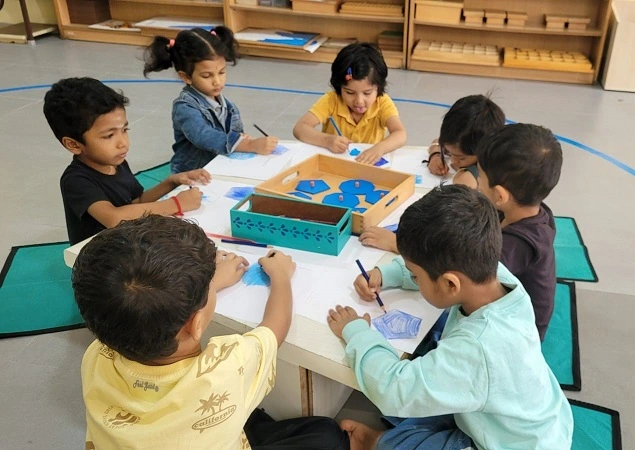
The Montessori method was developed over 100 years ago by Dr. Maria Montessori, an Italian doctor and educator. Instead of a teacher standing at the front of a class telling children what to do, Montessori classrooms let children choose their own activities, learn at their own pace, and discover things hands-on using specially designed materials.
Think of it this way: rather than pouring knowledge into a child like filling a bottle, Montessori lights a spark of curiosity and lets the child explore on their own — with a teacher gently guiding rather than instructing. As Dr. Montessori herself put it, "Play is the work of the child" — something worth remembering the next time you see a Montessori classroom full of children busy with what looks like play, but is actually deep learning.
How Does It Actually Help Children?
1. Builds independence early
Children as young as 2-3 years old are encouraged to do things themselves — pouring water, buttoning a shirt, cleaning up after an activity. This builds confidence and self-reliance from a very young age.
2. Learning at their own pace
No two children learn the same way or at the same speed. Montessori classrooms let a child spend as much time as they need on something they're curious about, instead of rushing to keep up with a fixed schedule.
3. Hands-on, sensory learning
Children learn best by touching, moving, and doing — not just listening. Montessori materials are designed so kids learn concepts like counting, shapes, and letters through play and exploration.
4. Encourages focus and concentration
Because children choose activities they're genuinely interested in, they naturally develop longer attention spans — a skill that helps them well beyond preschool.
5. Respects the child as an individual
Rather than treating a classroom of 20 kids the same way, Montessori teachers observe each child and support their unique interests and strengths. Dr. Montessori believed this early independence shapes the person a child grows up to become — as she said, "It is the child who makes the man, and no man exists who was not made by the child he once was."
Success Stories: Where Did It Take Them?
It's worth noting — Montessori isn't a magic formula that guarantees success, and how long each of these people attended varied quite a bit. But it's telling how many well-known achievers credit their early years with shaping how they think and learn.
Larry Page & Sergey Brin, Founders of Google
Both went to Montessori school as children. Page has said the method taught him "not following rules and orders, and being self-motivated." Brin credited it with giving him the freedom "to discover" at his own pace.
Jeff Bezos, Founder of Amazon
Bezos attended a Montessori preschool for a year and a half as a child. He later said, "Education is not the filling of a pail, but the lighting of a fire" — a philosophy he carried into his own support for early education.
Gabriel García Márquez, Nobel Prize-Winning Author
Márquez openly credited his Montessori schooling, saying he didn't believe there was "a method better than Montessori" for awakening a child's curiosity about the world.
Stephen Curry, NBA Basketball Star
Curry attended Montessori school growing up and has said it "gave me a lot of confidence at a young age."
Anne Frank
Anne Frank attended a Montessori school in Amsterdam from age 3 until she was 11 — a formative period reflected in the observational, reflective way she wrote her diary.
Katharine Graham, First Female CEO of a Major American Newspaper
Graham led The Washington Post through some of its most difficult years. She later reflected that her early Montessori education stayed with her throughout her career, saying that "learning by doing" became her guiding approach to leadership.
What This Means for Parents
You don't need to raise the next tech billionaire or Nobel laureate — that's not really the point. What these stories show is that Montessori builds foundational life skills: curiosity, independence, focus, and confidence. These are qualities that help a child no matter what path they eventually take — whether that's engineering, medicine, the arts, or entrepreneurship.
For Indian families especially, where academic pressure often starts early, Montessori offers a gentler, more natural starting point — one where a love for learning is built before the pressure of exams and marks ever enters the picture.
At Preksha, our name itself means "perception" and "insight" — the very qualities Montessori nurtures in young children. We believe learning begins with curiosity, and we're here to nurture that in every child who walks through our doors.